 PQStat
The Brown-Forsythe test and the Levene test
When to use this test:
The Levene test (Levene, 1960[104]) and the Brown-Forsythe test (Brown and Forsythe, 1974[32]) let you check whether the spread (variance) of an analysed feature is the same in at least two populations. The result of this test is usually checked as a preliminary condition before performing the ANOVA for independent groups – it indicates whether the variant with the correction for unequal variances should be used.
Assumptions
- measurement on an interval scale,
- normality of distribution of the analysed variable in each population,
- an independent model.
How to set up the analysis
Statistics \(\to\) Parametric tests \(\to\) Levene, Brown-Forsythe.
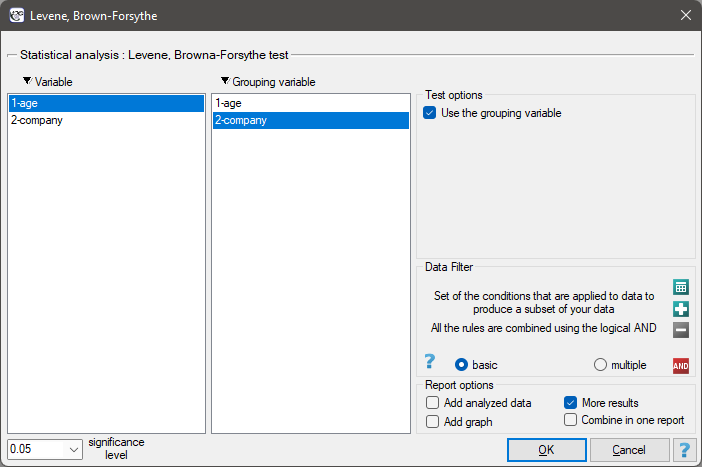
Performing and interpreting the analysis
In practice, these tests are performed as part of a broader analysis – an example of their use and interpretation can be found in the ANOVA for independent groups with \(F^*\) and \(F''\) corrections chapter (Example 1).
Hypotheses:
where \(\sigma_1^2\),\(\sigma_2^2\),...,\(\sigma_k^2\) – variances of the analysed variable in the populations from which the samples were drawn.
Procedure: The analysis is based on calculating the absolute deviation of the measurement results from the mean (in the Levene test) or from the median (in the Brown-Forsythe test) in each of the analysed groups. This absolute deviation is the set of data which undergoes exactly the same procedure as the analysis of variance for independent groups.
Formulas: the test statistic is defined by:
The test statistic has the F Snedecor distribution with \(df_{BG}\) and \(df_{WG}\) degrees of freedom.
The \(p\) value, determined on the basis of the test statistic, is compared with \(\alpha\): if \(p \le \alpha\), we reject \(\mathcal{H}_0\) in favor of \(\mathcal{H}_1\); if \(p > \alpha\), there is no reason to reject \(\mathcal{H}_0\).